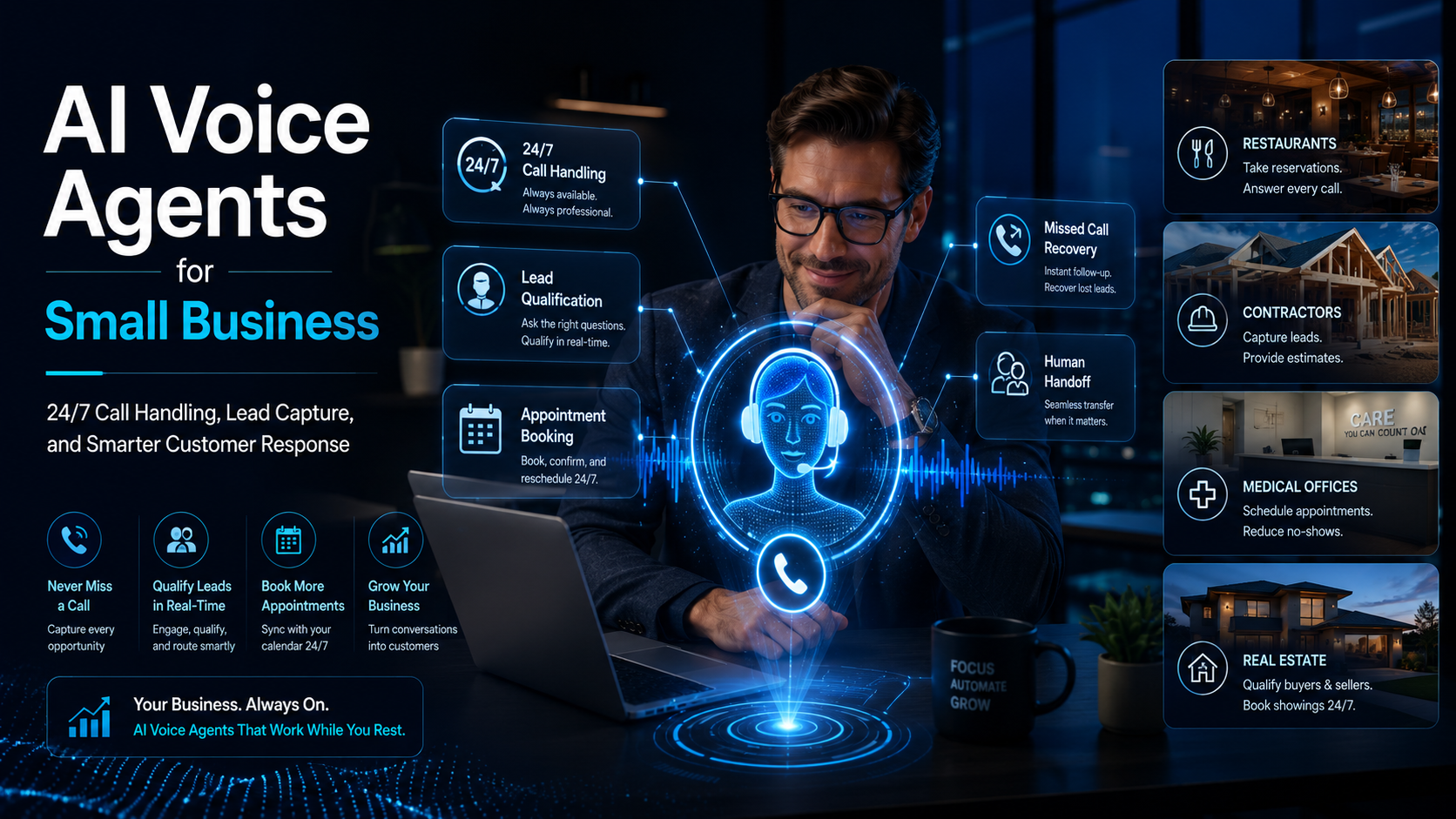
What this guide covers
- Choose one call type and define what the voice agent may say, collect, look up, change, and promise before selecting a voice or platform.
- Test real conversational pressure: interruptions, silence, corrections, names, numbers, noise, ambiguity, tool failures, and requests for a person.
- Measure confirmed facts, successful transfers, correction burden, policy adherence, and recovery—not how natural one demonstration sounds.
The first decision
Choose one call
An AI voice agent is a spoken interface connected to instructions, conversation state, and selected tools. OpenAI’s current Voice Agents documentation describes low-latency speech interactions with tools, guardrails, handoffs, and session history. For a small business, the useful starting point is one narrow call purpose—not a promise to replace the phone team.
Good first call
The reason for calling is common, the approved answers are stable, the needed details are limited, and a person can take over quickly.
After-hours service-area and estimate-request intake for one line of business.Use a recorded menu
The choices are fixed and callers do not need a conversational exchange to reach the right destination.
Press one for hours, two for directions, or three for an existing-order queue.Keep it human-led
The call commonly involves distress, disputes, sensitive facts, professional judgment, complex negotiation, or safety-critical interpretation.
A medical symptom discussion, legal advice request, urgent hazard assessment, or contested billing decision.Scope
Write the call contract
Write the contract in language a staff member can hear and verify. It should cover the opening, the allowed job, every data field, every tool, the confirmation wording, and the exit path.
- Identify the business and the AI role.Use a brief opening that tells the caller who answered and what the system can help with.
- Name the supported call reasons.List the few intents the pilot can handle and route everything else.
- Limit collection.Ask only for the details needed for this workflow and avoid collecting sensitive information without an approved purpose and process.
- Separate knowledge from action.List what the agent may explain, what it may look up, and what it may change in a business system.
- Write exact confirmation behavior.Require the agent to repeat critical names, phone numbers, addresses, dates, times, and requested services before treating them as confirmed.
- Define the transfer packet.Choose the destination and the facts, transcript caveat, caller request, and attempted actions that the person receives.
- Provide an immediate exit.A direct request for a person, a safety concern, a blocked tool, or repeated misunderstanding should trigger the written fallback.
Conversation path
Map the live call
Open
Identify the business and AI role, then state the narrow help available.
Understand
Let the caller explain, reflect the intent in plain language, and ask one question at a time.
Verify
Confirm critical facts and separate caller-provided information from business records.
Act or pause
Use only approved tools, seek required approval, and do not imply completion before the tool result is verified.
Confirm
State what happened, what did not happen, and what the caller should expect next.
Transfer or close
Reach the correct person or queue with context, or close with a clear next step and reference.
Realtime voice systems also have turn-detection and interruption behavior. OpenAI’s Realtime API documents server voice-activity detection, interruption controls, and a separate input-transcription process. Its documentation cautions that a transcript may differ from the model’s interpretation and should be treated as a rough guide. A transcript is useful evidence, but it is not a perfect record of what either party heard.
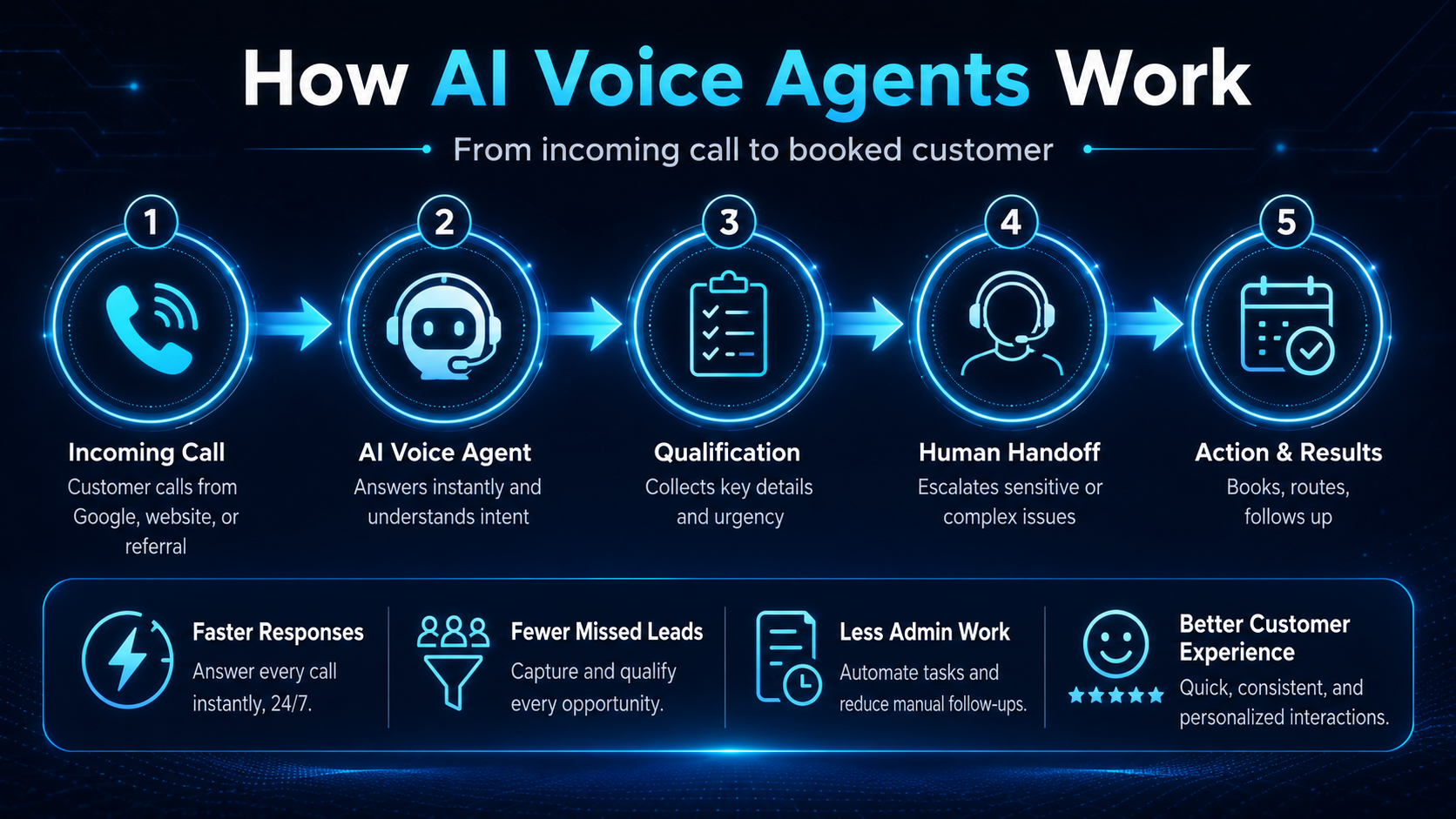
Escalation
Build the handoff matrix
A handoff is complete only when the next owner receives the context and the caller receives an accurate expectation. “Someone will call you” is not enough if no queue, service level, or failure path exists.
Caller asks for a person
Honor the request without forcing more questions. Preserve only the context the caller agreed to provide.
Warm transfer during staffed hours; named callback queue after hours.Agent is uncertain
After one focused clarification, stop guessing and transfer with the original wording and unresolved question.
The requested service could fit two categories with different staff owners.Tool is unavailable
Do not claim a lookup, booking, payment, or update succeeded. Offer the approved fallback and log the failure.
Calendar access fails, so the agent records a scheduling request instead of inventing availability.Sensitive or high-risk topic
Use the business’s approved safety wording and route immediately. The agent should not improvise professional judgment.
The caller describes danger, distress, a dispute, or information outside the approved workflow.Repeated misunderstanding
Set a low retry limit. Transfer before the caller becomes trapped in a loop.
The agent fails twice to confirm a surname, address, date, or requested service.Evaluation deck
Test real utterances
A text script does not reproduce a live call. Build audio cases from the language, pace, accents, devices, and environments your business actually encounters, with consent and appropriate handling for any recordings used. Start with synthetic or staff-created cases before using customer calls.
Minimum categories for a first test deck
- The caller interrupts the greeting or changes direction mid-sentence.
- Long silence, background noise, speakerphone echo, or a weak connection affects turn detection.
- The caller corrects a name, number, address, date, time, or service after the agent repeats it.
- The caller gives two intents in one answer or answers a different question than the one asked.
- The caller uses an unfamiliar pronunciation, local place name, abbreviation, or trade term.
- The caller requests a person immediately or expresses frustration with automation.
- The approved knowledge does not contain the answer.
- A lookup returns nothing, times out, conflicts with the caller, or succeeds after a delay.
- A write action fails, duplicates, or returns an ambiguous state.
- The caller asks the agent to ignore rules, reveal private data, or make an unsupported promise.
- The call drops before confirmation or during transfer.
- The caller raises a safety, legal, medical, payment, or dispute topic outside the pilot.
Illustrative scenario
Worked example: after-hours intake
A caller reaches a landscaping company after hours and asks about spring cleanup. The pilot voice agent identifies itself as the company’s automated assistant, says it can collect a request for the team, and asks for the service address, requested work, callback number, and preferred contact window. It checks only the approved service-area list.
It may say
Which towns the company serves, what information the estimate team needs, and when the staffed callback window begins.
It may do
Create a pending intake record after confirming the address, phone number, and requested service with the caller.
It may not say
That the job qualifies, what it will cost, when work will happen, or that a person has accepted the request.
It must hand off
The caller disputes prior work, requests an unsupported service, asks for a binding quote, or wants a person.
At the close, the agent reads back the key facts and says exactly what was created: a request for staff review, not an estimate or appointment. That distinction is both a customer-experience choice and a claim-control boundary.
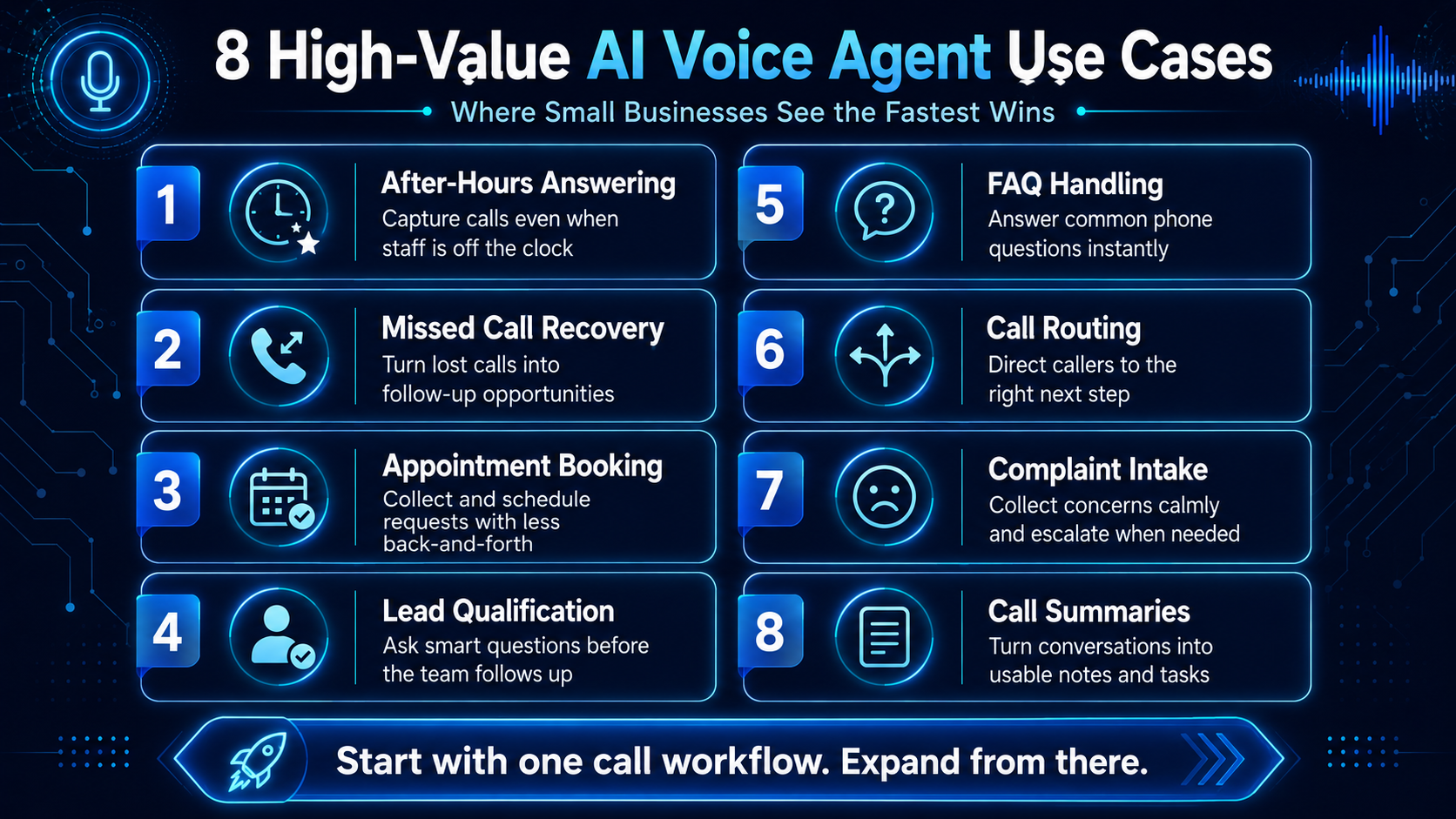
Policy and legal review
Check identity, consent, and privacy
Use an opening that is clear about the business and AI role. That is MediaMentorAI’s trust and claim-control recommendation, not a statement that one disclosure rule governs every call. Review the provider contract and the laws that apply to the exact workflow.
Inbound answering and outbound calling should not be treated as the same legal workflow. In a February 2024 declaratory ruling, the U.S. Federal Communications Commission confirmed that TCPA restrictions on artificial or prerecorded voice encompass current AI-generated human voices. Calls subject to those restrictions require prior express consent, and covered telemarketing calls have stricter written-consent requirements. Before any outbound pilot, obtain advice for the exact numbers, purpose, consent record, jurisdiction, and exemptions involved. If a system uses a real person’s voice likeness, consent and authenticity rules also matter; OpenAI’s current Usage Policies, for example, prohibit using someone’s voice without consent in ways that could confuse authenticity.
Owner review questions
- Does the opening identify the business, the automated role, and the available human path?
- Which calls are inbound, outbound, returning an inquiry, or telemarketing, and what consent record supports each path?
- Is recording or transcription enabled, what notice or consent is required, and how long is the data retained?
- Which vendor and subprocessors receive audio, transcripts, contact details, or tool data?
- Can a caller complete the same essential task through an accessible alternative?
- Who handles deletion, access, correction, complaint, and opt-out requests?
Pilot scorecard
Measure call quality
Fact confirmation
Were critical names, numbers, addresses, dates, times, and services read back and accepted before use?
Intent and scope
Did the agent correctly handle, decline, or transfer the call under the written contract?
Transfer completion
Did the correct person or queue receive usable context, and did the caller receive an accurate expectation?
Tool truthfulness
Did spoken claims about lookups or actions match the actual tool result and final business record?
Conversation friction
Track repeated questions, corrections, talk-over events, silence recovery, loops, abandonment, and requests for a person.
Policy adherence
Did every case follow identity, consent, data, retention, claim, approval, and prohibited-topic rules?
Set thresholds from the consequences of this call type. Preserve the failed examples and listen to them; an average can conceal one serious boundary failure. Stop the pilot on unauthorized action, a misleading completion claim, a required-transfer failure, unapproved data exposure, or missing evidence needed for review.
Rollout
Stage the voice pilot
- Script and replay.Use synthetic or consented staff audio with tools disconnected. Fix identity, turn-taking, confirmation, and unsupported requests.
- Connect read-only tools.Test lookups, empty results, stale records, timeouts, and conflicting sources without allowing changes.
- Shadow the staffed process.Let staff hear or review proposed outcomes while people still own the live customer action.
- Limit live intake.Open one call type or time window, keep a visible human exit, review every exception, and maintain a tested shutoff.
Before live calls
Owner decision checklist
- Can the team name the one supported call type and every unsupported topic?
- Does the opening accurately identify the business and AI role?
- Are critical facts repeated and confirmed before any action?
- Does a request for a person work immediately?
- Do tool failures produce an honest fallback instead of a false completion claim?
- Has the team tested audio, transcript, event log, tool result, and final record together?
- Are outbound consent, recording, transcription, retention, privacy, and accessibility questions resolved for this exact workflow?
- Are stop rules and a real shutoff assigned to a named owner?
Evidence
Sources reviewed
FAQ
AI Voice Agents FAQ
What is an AI voice agent?
It is a spoken interface connected to model instructions, conversation state, and selected tools. A business implementation may answer approved questions, collect details, look up information, prepare or take limited actions, and hand the call to a person.
What is a good first call for an AI voice agent?
Choose one common, low-risk call with stable source material, limited data, clear confirmation, and a reliable human fallback. After-hours request intake is easier to bound than a broad promise to handle every call.
Should a voice agent tell callers it is AI?
MediaMentorAI recommends a clear opening that identifies the business and automated role. Provider contracts and legal duties can differ, so review the exact jurisdiction, call type, recording or transcription setup, and technology before launch.
Can an AI voice agent book appointments?
It can be connected to availability and booking tools, but that adds a write action and new failure cases. The workflow should confirm critical facts, distinguish a request from a completed booking, prevent duplicates, and hand off on conflicts or uncertain eligibility.
How should a business test a voice agent?
Use audio cases with interruptions, silence, noise, corrections, unfamiliar names, multiple intents, human requests, unsupported questions, tool failures, duplicates, and dropped calls. Review audio, logs, transcript, tool results, and the final business record together.
Are voice-agent transcripts exact?
Do not assume they are. OpenAI’s Realtime documentation says input transcription is separate from the model’s audio interpretation and may diverge, so treat a transcript as a rough guide and retain other evidence appropriate to the workflow.
Do U.S. outbound AI voice calls require consent?
The FCC has confirmed that TCPA restrictions for artificial or prerecorded voice include current AI-generated human voices. Whether a specific call is covered and what form of consent is required depends on the number, purpose, content, relationship, and any exemption. Get advice for the exact outbound workflow.
What should trigger an immediate human handoff?
A direct request for a person, repeated misunderstanding, a blocked tool, a sensitive or high-risk topic, disputed facts, an unsupported request, or any point where the agent would exceed its written authority.