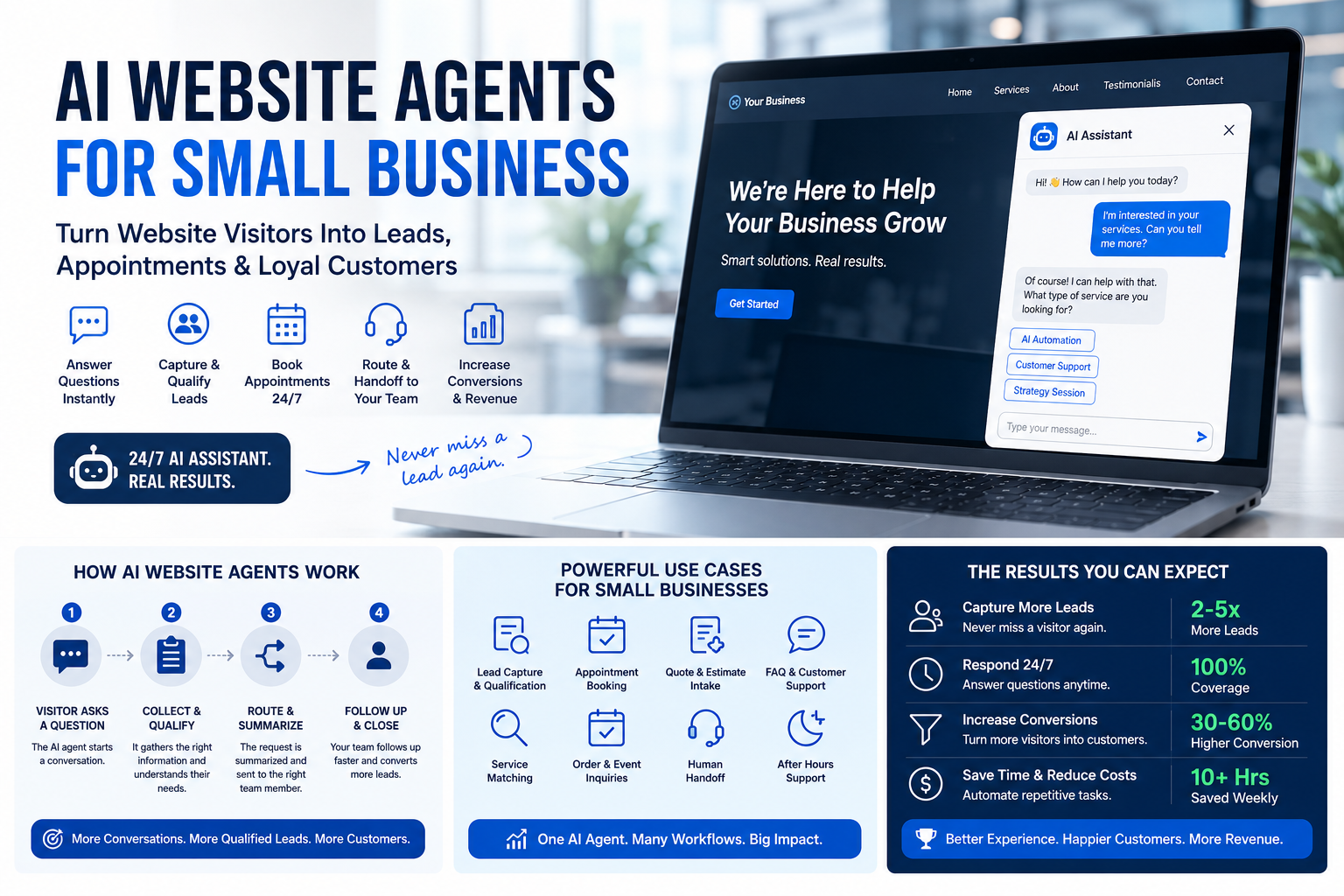
What this guide covers
- Most small business websites do not have a traffic problem first. They have a conversion problem.
- A strong website agent can answer questions, capture details, qualify the visitor, summarize the inquiry, and route the next step.
- The best first workflows are lead capture, FAQ support, appointment requests, quote intake, service matching, and human handoff.
Definition
What Is an AI Website Agent?
An AI website agent is an AI-powered assistant on a business website that can answer questions, guide visitors, collect details, qualify inquiries, and move a real workflow forward.
A normal website waits for the visitor to figure everything out. The visitor has to understand the services, compare options, decide whether the business fits, find the right form, and hope someone responds quickly.
A website agent starts a conversation. It can answer approved questions, explain services, collect contact information, ask follow-up questions, summarize what happened, and route the request to the right person or system.
Conversion Problem
Why Small Business Websites Need AI Agents
Most small business websites do not have a traffic problem first. They have a conversion problem. Someone visits the homepage, checks a service page, maybe reads a few reviews, and leaves without taking the next step.
Sometimes they had a real question. Sometimes they wanted pricing guidance. Sometimes they needed an appointment. Sometimes they were comparing three local businesses and simply chose the one that made the next step easiest.
Website visitors often leave because:
- They cannot quickly find the answer they need.
- They are not ready to call but would ask a quick question.
- They are browsing after hours.
- They are comparing competitors.
- They are not sure which service applies to them.
- The contact form feels too slow or too generic.
- The next step is unclear.
A website agent turns the site from a passive brochure into a guided response system.
MediaMentorAI
Clear Terms
AI Website Agent vs. Chatbot
Chatbot
A chatbot usually answers simple questions from a fixed knowledge base or FAQ.
Example: What are your hours? We are open Monday through Friday from 9 AM to 5 PM.Website Assistant
A website assistant may answer questions and point visitors toward the right page or service.
Example: Based on your needs, our automation services may be a good fit. You can learn more here.Website Agent
A website agent handles a workflow: answer, qualify, capture, summarize, route, and hand off.
Example: Restaurant owner interested in an AI agent for catering inquiries and after-hours response. Requested follow-up by phone.The label matters less than the behavior. If the system only answers a question, it is a chatbot. If it helps the visitor become a qualified inquiry with clean context, it is operating like a business agent.
Silent Drop-Off
Website Visitors Leave Without Converting
Website analytics can tell you that someone visited a page and left. They usually cannot tell you what question went unanswered, what objection stopped the visitor, or what service they were trying to understand.
A website agent can meet visitors in that moment by asking a simple question: What are you looking for help with today? That opens the door to a more useful customer experience than forcing every visitor into the same contact form.
Fastest Wins
Best AI Website Agent Use Cases for Small Businesses
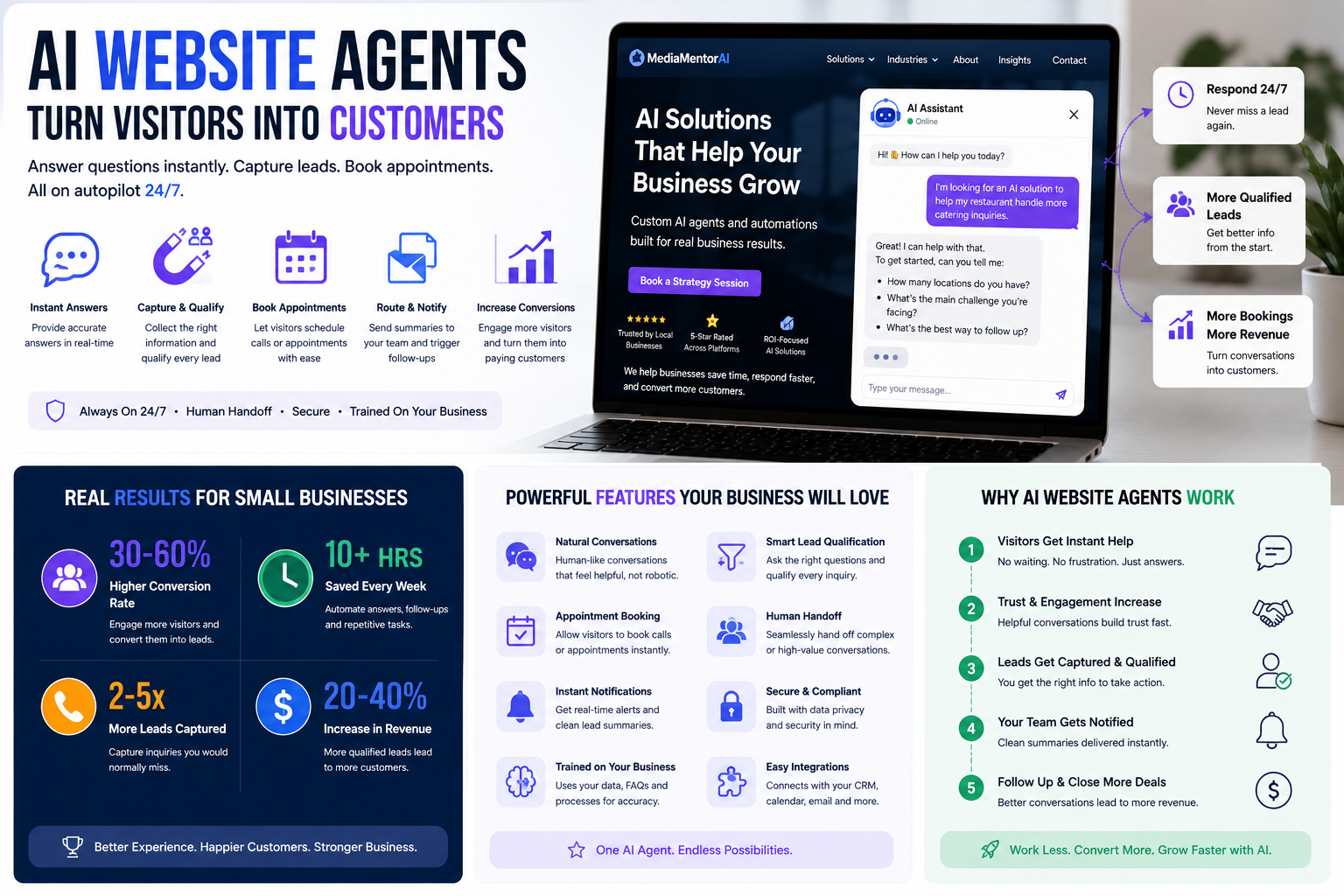
Website Lead Capture
Turn anonymous visitors into real inquiries by collecting name, phone, email, service need, location, urgency, and preferred follow-up method.
Customer Service Questions
Answer common questions about hours, location, services, service areas, appointment process, policies, and what to expect next.
Appointment Requests
Guide visitors through service type, new or returning customer status, preferred time, location, urgency, and contact method.
Quote and Estimate Intake
Collect project details, town, timeline, urgency, photos, and context before the team gets involved.
Service Matching
Help visitors describe the problem in their own words and guide them toward the service, agent, or automation that fits.
Human Handoff
Escalate upset visitors, urgent requests, high-value leads, sensitive questions, and anything the AI cannot answer confidently.
FAQ and Content Ideas
Use real visitor questions to improve FAQs, service pages, blog topics, Google Business Profile posts, and sales materials.
Local Business Conversion
Help local buyers quickly understand service areas, availability, appointment options, and the next step.
Quality Bar
What a Good AI Website Agent Should Do
- Answer clearlyUse approved business knowledge about services, hours, locations, service areas, policies, process, FAQs, and contact options.
- Capture the right informationStart light, then ask only what is needed for the visitor's situation.
- Qualify without pressureAsk helpful questions about urgency, service fit, location, timeline, and preferred next step.
- Summarize the conversationGive the team the visitor's need, contact details, urgency, context, and recommended next step.
- Route the requestSend sales leads, service requests, complaints, vendor messages, job inquiries, and urgent issues to the right destination.
- Stay on brandSound confident, helpful, practical, and clear without becoming pushy, robotic, or vague.
Guardrails
What AI Website Agents Should Not Do
A website agent should not be treated like a magic employee with no rules. It should be scoped around approved knowledge, clear escalation, and a real follow-up process.
A website agent should not:
- Make promises the business cannot keep.
- Give legal, medical, financial, or regulated advice without approval.
- Quote exact prices when pricing depends on context.
- Argue with customers or hide escalation options.
- Pretend to be human.
- Collect unnecessary sensitive information.
- Guess when it does not know.
- Trap visitors in an AI conversation.
The safest and most effective website agents answer what they know, ask useful questions, and hand off when needed.
Industry Fit
AI Website Agents for Different Industries
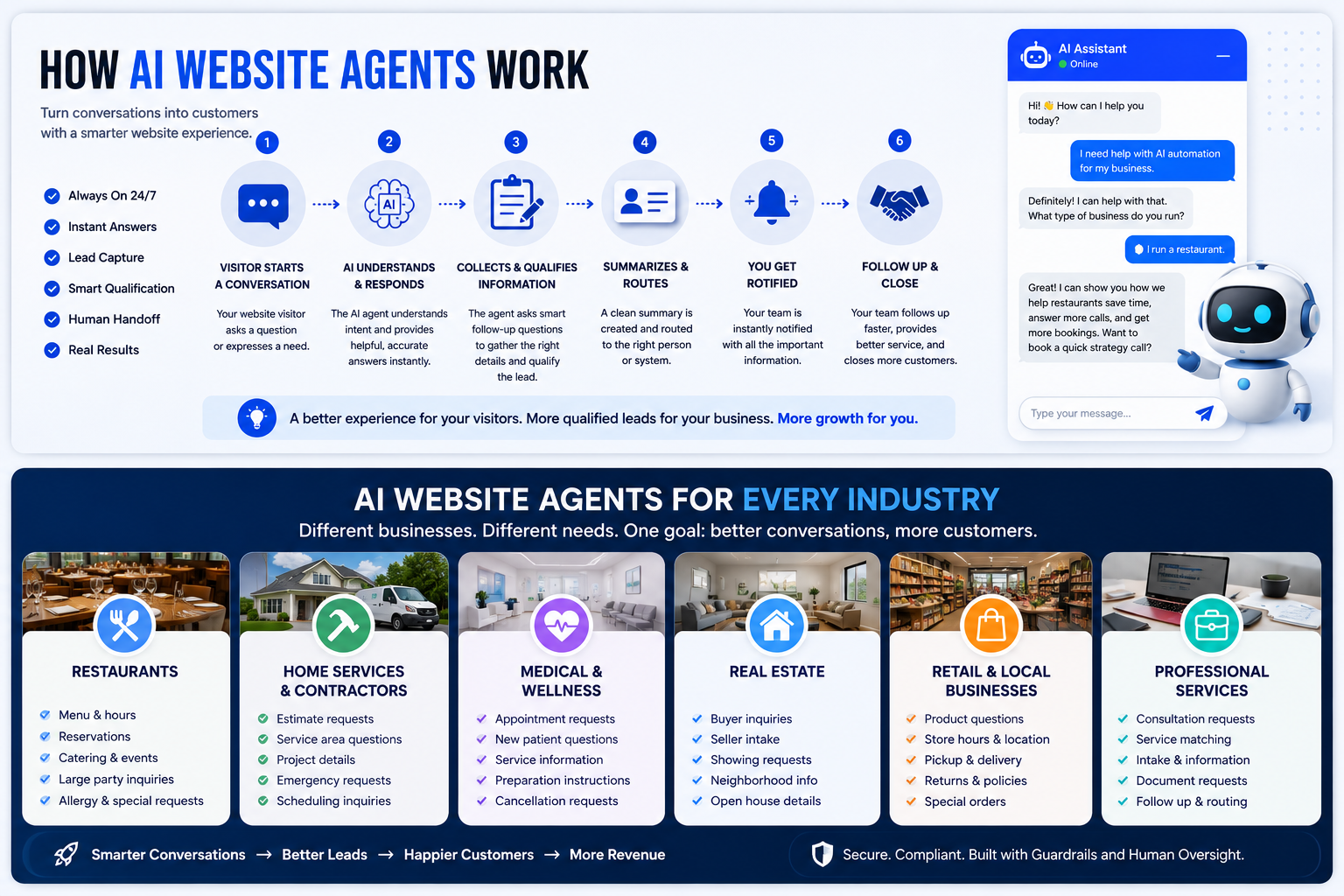
This topic should rank broadly, but industry examples help business owners see themselves in the workflow. A restaurant, contractor, wellness office, realtor, retail store, and professional service firm all need different questions, routing, and handoff rules.
Restaurants
Answer menu, hours, reservations, catering, private event, parking, location, and dietary questions with handoff for allergies and complaints.
Home Services and Contractors
Collect estimate requests, service area questions, emergency intake, project details, scheduling needs, photos, and urgency classification.
Medical and Wellness Offices
Support appointment requests, service descriptions, office hours, new patient questions, preparation instructions, and staff callback routing.
Real Estate
Qualify buyer and seller inquiries, showing requests, property questions, neighborhood questions, open house details, and agent handoff.
Professional Services
Collect consultation requests, intake details, service matching, appointment preferences, document reminders, and follow-up summaries.
Local Retail
Answer product questions, store hours, location questions, pickup options, appointment shopping, special orders, and return policy basics.
Search Value
How AI Website Agents Improve SEO
A website agent can support SEO indirectly by revealing what visitors actually ask before they convert or leave. That is more useful than guessing content topics from a generic keyword list.
A website agent can reveal:
- Which services confuse visitors.
- Which objections come up repeatedly.
- Which local areas visitors mention.
- Which questions deserve FAQ answers.
- Which industries need dedicated landing pages.
- Which content topics come from real demand.
Google's helpful content guidance emphasizes useful, reliable, people-first content. Real customer questions can help create better FAQs, service pages, local guides, video scripts, and blog topics without drifting into thin AI content.
First Workflow
The Best AI Website Agent Strategy
The best strategy is not to launch a giant AI system all at once. Start with one focused workflow, make it excellent, then expand.
FAQ Assistant
Best when visitors ask repeat questions and staff spend too much time replying manually.
Lead Capture Assistant
Best when the site gets traffic but too few visitors become real inquiries.
Appointment Request Assistant
Best when scheduling creates back-and-forth or visitors need a guided intake flow.
Quote Intake Assistant
Best when the team needs project context before estimating or recommending a next step.
Strategy Session Intake Agent
Best for MediaMentorAI-style consultative services where the visitor needs help identifying the first AI opportunity.
Support Handoff Assistant
Best when common service questions can be answered, but sensitive issues should move to a human quickly.
Knowledge Base
What Information Does a Website Agent Need?
A website agent should be built around approved business information, not random internet content. The better the knowledge base, the more useful and trustworthy the agent becomes.
Before building, gather:
- Business description, services, locations, service areas, and hours.
- FAQs, policies, pricing guidance, and appointment rules.
- Intake questions, escalation rules, and human handoff instructions.
- Brand tone, disallowed topics, and what the AI should never answer.
- CRM, email, calendar, or form destinations.
- Follow-up process and success metrics.
Outcomes
How to Measure Whether an AI Website Agent Is Working
A website agent should be judged by useful business outcomes, not by the novelty of having a chat bubble on the site.
Track metrics like:
- Conversations started and leads captured.
- Conversion rate and appointment requests.
- Qualified leads and human handoffs.
- Average response time and staff time saved.
- Most common visitor questions and objections.
- Form abandonment reduction.
- Revenue or booked calls tied to agent-assisted leads.
Practical Risks
Common Mistakes to Avoid
- Making the agent too genericA generic bot will feel generic. The agent should know the business, services, process, and tone.
- Asking for contact info too earlyOpen with help, then ask for contact details when the conversation has earned it.
- Skipping human handoffGive visitors a clean path to a person when the topic is urgent, sensitive, high value, or outside scope.
- Letting the agent guessIf the agent does not know, it should say so and route the question.
- Not reviewing conversationsThe first version will need refinement. Review real conversations, update knowledge, and improve flows.
- Treating it like a toyA website agent should connect to a real workflow: where the lead goes, who follows up, what gets summarized, and what escalates.
30 Days
AI Website Agent Launch Plan
- Week 1: Choose the workflowPick one purpose such as strategy session leads, website FAQs, catering inquiries, home service estimates, consultation requests, or support routing.
- Week 2: Build the knowledge baseCollect FAQs, services, policies, tone, routing rules, escalation rules, and approved answers.
- Week 3: Build and testTest realistic questions like 'What do you do?', 'Can you help my restaurant?', 'Do you work in New Jersey?', and 'Can I book a call?'
- Week 4: Launch and measureLaunch carefully, then track chats, leads captured, top questions, escalations, conversion rate, staff feedback, and follow-up outcomes.
Build the full response system
Decision
Should Every Small Business Add an AI Website Agent?
Consider One If
Visitors are not converting, staff answer repeat questions, leads arrive after hours, forms are weak, or visitors need help choosing a service.
Best fit: a business with real website traffic and a follow-up process that can act on new inquiries.Pause If
The website has almost no traffic, the offer is unclear, there is no follow-up process, or no one owns inquiry review.
Better first step: clarify services, FAQs, policies, routing, and who handles new leads.Start Narrow
Choose one workflow, launch it carefully, and improve based on real visitor questions.
Example: strategy session intake before a fully connected website support agent.AI works best when it supports a real business process. For small businesses in Toms River, Ocean County, New Jersey, and beyond, that process usually starts with faster answers, better lead capture, and cleaner follow-up.
Website Conversion
Final Thoughts
An AI website agent can turn a small business website from a passive brochure into an active customer response system.
It can answer questions, capture leads, qualify inquiries, route sensitive issues, summarize conversations, and help the team respond faster. The goal is not to replace the human side of the business. The goal is to make sure fewer opportunities slip away.
Make the website easier to use. Answer questions faster. Capture more leads. Give the team cleaner follow-up information.
MediaMentorAI
Evidence
Sources reviewed
FAQ
AI Website Agents FAQ
What is an AI website agent?
An AI website agent is an AI-powered assistant on a website that can answer questions, capture leads, qualify visitors, summarize conversations, and route requests to the right person or workflow.
Is an AI website agent the same as a chatbot?
Not exactly. A chatbot usually answers questions. An AI website agent can support a full workflow, including lead capture, qualification, appointment requests, summaries, routing, and human handoff.
How can an AI website agent help a small business?
It can answer common questions, reduce repetitive emails and calls, collect lead details, qualify inquiries, support appointment requests, and improve website conversion.
Can an AI website agent book appointments?
Yes, depending on setup. It can either book directly through a connected calendar or collect appointment preferences for staff to confirm.
Can an AI website agent help with local SEO?
Yes, indirectly. It can identify the real questions customers ask, which can become FAQs, blog posts, service page updates, Google Business Profile content, and stronger local landing pages.
Should an AI website agent replace my contact form?
Usually no. It should support the contact form, not necessarily replace it. Some visitors prefer forms, while others prefer a guided conversation.
What should an AI website agent not do?
It should not make promises, guess answers, handle sensitive issues without escalation, pretend to be human, collect unnecessary sensitive information, or give regulated advice unless the workflow is specifically approved.
Is an AI website agent good for restaurants?
Yes. Restaurants can use website agents for menu questions, catering inquiries, private event requests, reservations, hours, and handoff for allergies or complaints.
Is an AI website agent good for contractors?
Yes. Contractors can use website agents to collect project details, qualify leads, confirm service areas, classify urgency, and prepare estimate requests.
What is the best first AI website agent to build?
The best first version is usually a lead capture agent, FAQ assistant, appointment request agent, or quote intake agent. Start with one workflow, make it excellent, then expand.