What this guide covers
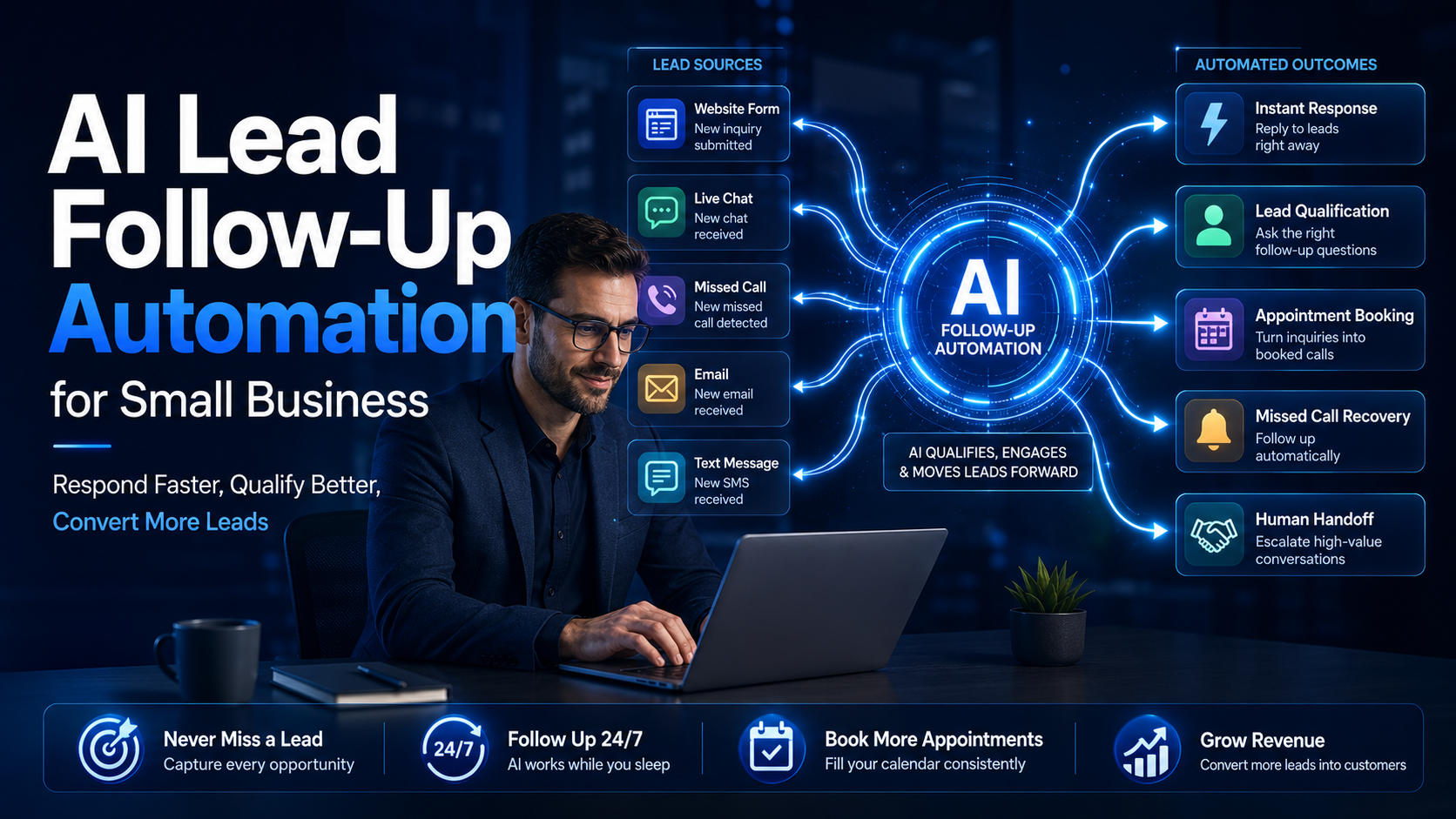
- AI lead follow-up automation helps every inquiry get acknowledged, qualified, routed, and moved toward a clear next step.
- The best systems connect website forms, chats, missed calls, texts, emails, appointments, summaries, and staff reminders without overwhelming real customers.
- Small businesses in Toms River, Ocean County, New Jersey, and beyond should start with one high-value follow-up workflow before expanding across channels.
Definition
What Is AI Lead Follow-Up Automation?
AI lead follow-up automation is a response system that uses AI and business rules to acknowledge new inquiries, ask useful follow-up questions, collect missing details, and move each lead toward the right next step.
A simple autoresponder sends the same message to everyone. A practical AI follow-up system can understand whether the inquiry came from a form, chat, missed call, text, email, quote request, or appointment request, then respond in a way that matches the situation.
Generic Autoresponder
Acknowledges the message, but usually stops there. The business still has to interpret the request, chase missing information, and remember the next step.
Example: Thanks for contacting us. Someone will be in touch soon.AI Follow-Up Agent
Acknowledges the inquiry, asks the right questions, classifies urgency, summarizes the opportunity, and routes it to the right person or workflow.
Example: New lead in Toms River, urgent service request, phone preferred, human callback recommended.Revenue Risk
Why Lead Follow-Up Matters So Much
Most small businesses do not lose leads because people are not interested. They lose leads because follow-up is too slow, too inconsistent, or too manual.
A customer calls after hours. A website visitor fills out a form. Someone asks a question in chat. A missed call comes in during a busy moment. A quote request lands in the inbox. Then the lead waits while the team is serving customers, running jobs, answering phones, or handling the day.
Older Harvard Business Review research helped popularize the response-speed problem for online leads. The tools have changed since then, but the business risk is familiar: when a customer shows intent and does not hear back quickly, they may keep looking.
Lead follow-up is not just a sales task. It is part of the customer experience.
MediaMentorAI
Channel Sprawl
Leads Arrive in Too Many Places
Small business leads rarely arrive in one clean inbox. They come from website forms, website chat, phone calls, missed calls, voicemail, text messages, email, Google Business Profile, Facebook messages, Instagram DMs, referral partners, event inquiries, ads, landing pages, walk-ins, and existing customer referrals.
The usual failure points
- The owner thinks the team followed up.
- The team thinks someone else handled it.
- The customer gave partial information and nobody filled the gap.
- A voicemail or form submission lands after hours and waits until morning.
- A high-intent inquiry is buried under routine messages.
- No one can easily see which leads still need attention.
Comparison
AI Lead Follow-Up vs. Traditional Automation
Traditional automation is useful when the workflow is predictable. If someone fills out a form, send an email. If an appointment is booked, send a reminder. Those rules still matter.
The problem is that business inquiries are not always identical. A restaurant catering lead needs different follow-up questions than a contractor estimate request. A medical or wellness appointment inquiry needs different boundaries than a real estate showing request. An AI automation lead for MediaMentorAI needs a different intake path than a basic support message.
Traditional Automation
Best for predictable tasks with fixed triggers and fixed outcomes.
When a form is submitted, send a confirmation email and add a row to a spreadsheet.AI Follow-Up Automation
Best when the system needs to interpret intent, ask different questions, classify urgency, and prepare a useful summary.
A missed call from an urgent service lead gets a different follow-up than a general pricing question.Connected Agent Workflow
Best when follow-up should connect to calendars, inboxes, CRMs, task boards, reports, and human handoff rules.
The AI qualifies the lead, routes it to the right person, and creates the callback reminder.Fast Wins
Best AI Lead Follow-Up Use Cases
Website Form Follow-Up
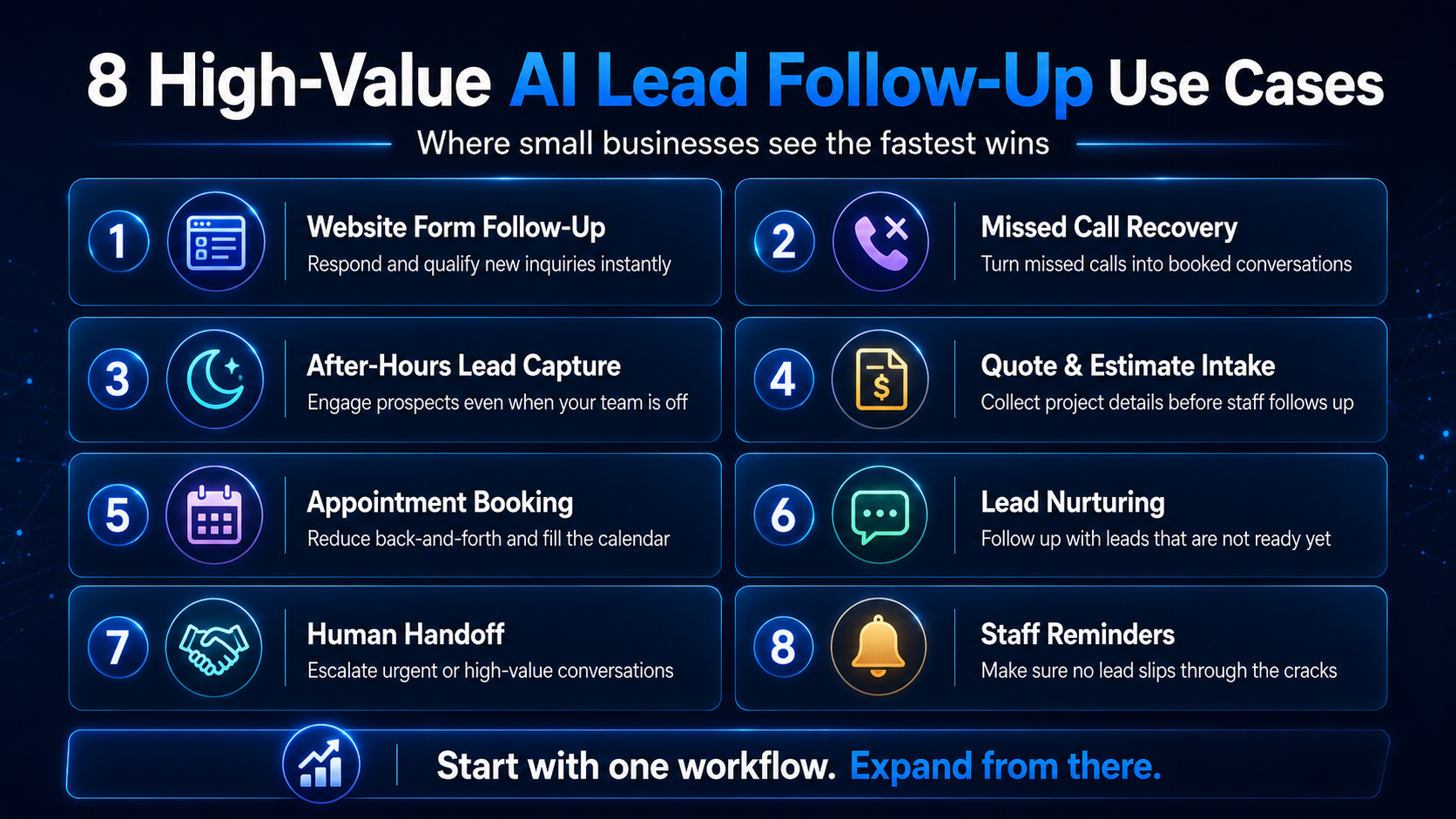
Continue the conversation after a form submission by collecting the service need, location, urgency, preferred contact method, and any details the team needs before responding.
Missed Call Recovery
Send a helpful text or message after a missed call so the customer can explain what they need while the business is still busy.
After-Hours Lead Capture
Acknowledge inquiries at night or on weekends, answer approved questions, determine urgency, and prepare a clean summary for the next business day.
Quote and Estimate Intake
Ask the missing questions before the team gets involved, such as project type, town, urgency, event date, guest count, budget range, or existing tools.
Appointment Booking Follow-Up
Collect preferred dates, times, service type, location, contact details, and special notes so staff can confirm faster or book directly when connected.
Lead Nurturing
Separate ready-now leads from future opportunities, information seekers, existing customers, and support requests so the next message fits the person.
Human Handoff
Escalate urgent, sensitive, high-value, or complex situations to a person with context instead of a raw transcript.
Staff Reminders
Create follow-up reminders when a callback, quote, appointment confirmation, pricing clarification, or owner review is needed.
System Design
What an AI Lead Follow-Up System Should Include
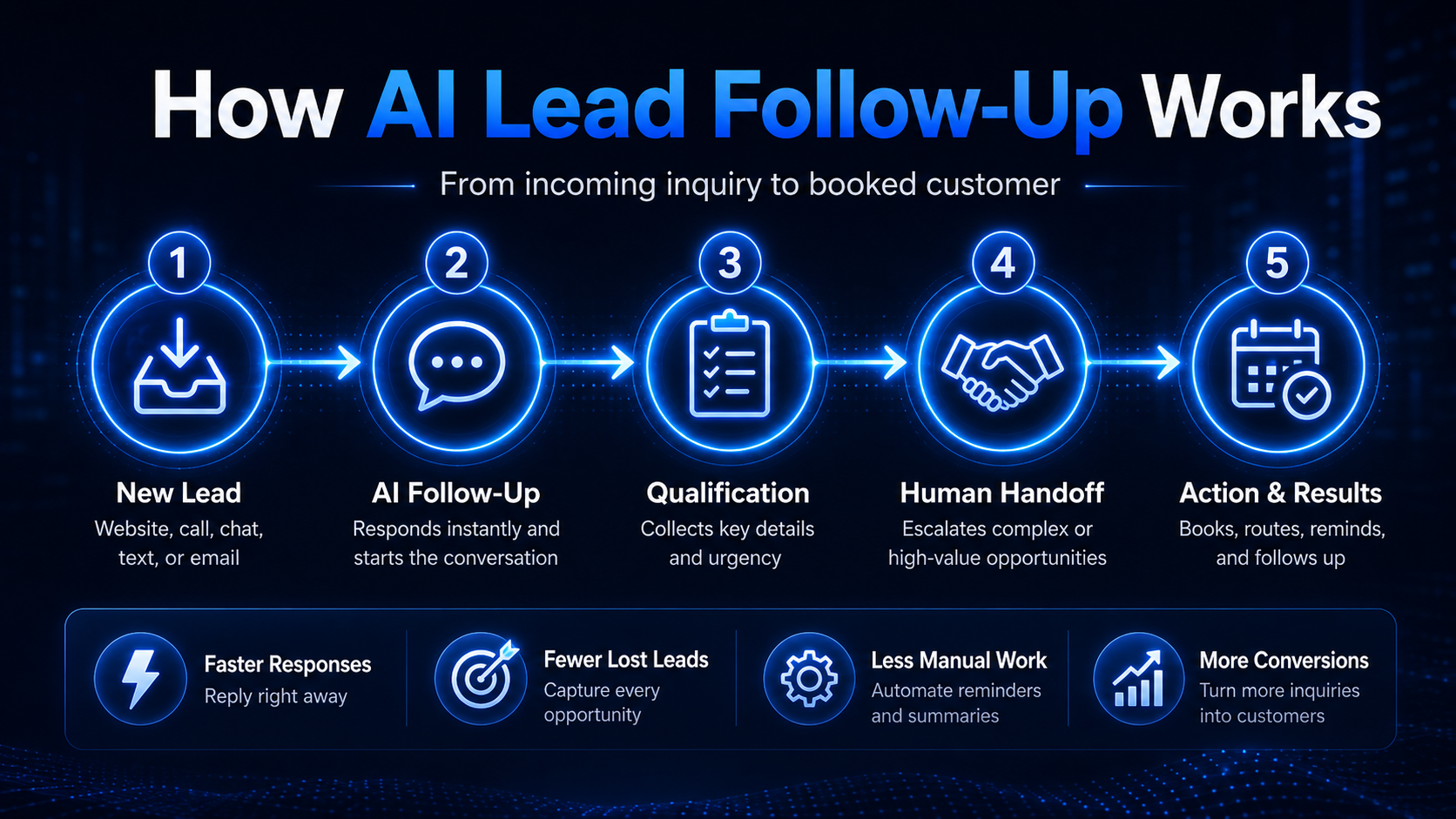
- Lead source detectionTrack whether the inquiry came from a form, chat, missed call, after-hours call, email, social message, referral, ad, or organic search.
- Fast acknowledgmentRespond quickly with a message that feels helpful, not canned. The customer should know the business received the inquiry and is ready to help.
- Smart qualificationAsk only the questions needed to move forward, such as service need, town, urgency, preferred contact method, and best time to follow up.
- Priority tagsLabel leads as same-day request, high-value opportunity, needs human review, outside service area, existing customer, complaint, or low intent.
- Clean summariesSend the team a short, useful summary with who contacted the business, what they need, why it matters, and what should happen next.
- Routing and remindersMove the lead to the right person, inbox, calendar, CRM, spreadsheet, task board, or notification channel, then remind the team when action is due.
- Tracking and reportingMeasure lead source, response time, appointment requests, human handoffs, no-response leads, common questions, and follow-up outcomes.
Local Examples
AI Lead Follow-Up for Different Industries
The best AI follow-up workflows are specific to the business. A restaurant, contractor, wellness office, real estate professional, retail store, and consultant may all need faster response, but the intake questions and handoff rules are different.
Restaurants
Follow up on catering inquiries, private events, large parties, reservation questions, missed calls, menu questions, allergy handoff, and customer concerns.
Contractors and Home Services
Collect estimate details, town, urgency, project description, photos, appointment windows, and emergency routing before the team calls back.
Medical and Wellness
Handle appointment requests, new patient inquiries, service questions, cancellations, preparation instructions, and staff callback routing without giving medical advice.
Real Estate
Qualify buyer inquiries, seller leads, showing requests, open house questions, property valuation requests, and neighborhood questions.
Professional Services
Route consultation requests, service matching, intake questions, appointment booking, document reminders, and follow-up summaries.
Local Retail
Support product availability requests, special orders, pickup questions, event inquiries, return policy basics, and customer service handoff.
For local businesses in Toms River, Ocean County, and across New Jersey, the advantage is practical: customers often choose the business that responds clearly and quickly.
Own Use Case
AI Lead Follow-Up for MediaMentorAI
For MediaMentorAI, the clearest follow-up system is a Strategy Session Lead Follow-Up Agent. It would help turn website visitors, blog readers, solution page visitors, and AI automation inquiries into qualified strategy session requests.
A MediaMentorAI follow-up agent should ask
- What type of business do you run?
- What are you trying to improve first?
- Are missed opportunities coming from calls, website visitors, email, texts, forms, reviews, or internal admin work?
- Do you currently use a CRM, calendar, inbox, booking tool, spreadsheet, or task board?
- Are you looking to move quickly or exploring options?
- What is the best way for the team to follow up?
Guardrails
What AI Lead Follow-Up Should Not Do
AI follow-up should feel like attentive service, not pressure. The system should help people move forward, but it should never make the customer feel trapped, misled, or spammed.
Avoid these mistakes
- Do not spam leads with endless messages.
- Do not pretend the AI is a human.
- Do not make promises the business cannot keep.
- Do not quote exact prices unless the business has approved that workflow.
- Do not handle sensitive complaints without escalation.
- Do not give medical, legal, financial, or regulated advice.
- Do not ignore opt-out requests.
- Do not collect unnecessary sensitive information.
- Do not guess when information is missing.
Good AI follow-up should make the customer think: they got my message and they are paying attention.
MediaMentorAI
Search Strategy
How AI Lead Follow-Up Helps SEO
AI lead follow-up can support SEO indirectly because every conversation shows what customers actually care about before they convert.
Follow-up conversations can reveal
- Common questions that deserve FAQ answers.
- Local service-area demand across Toms River, Ocean County, and New Jersey.
- Pricing concerns and objections before booking.
- Confusing service pages that need clearer copy.
- Industry-specific use cases for future guides.
- Better calls to action for landing pages and blog posts.
Google's helpful content guidance emphasizes useful, reliable, people-first content. Lead follow-up conversations can help a business create content from real customer questions instead of guessing what to publish next.
Implementation
How to Build an AI Lead Follow-Up System
- Choose one lead sourceStart with website forms, website chat, missed calls, after-hours calls, quote requests, appointment requests, or strategy session inquiries.
- Define the goalDecide whether the AI should capture contact info, qualify the inquiry, book an appointment, route to the right person, send a summary, or trigger a reminder.
- Create the intake questionsStart with what the customer needs, where they are located, how urgent it is, the best way to follow up, and what the team should know.
- Create the handoff rulesEscalate angry customers, refund requests, medical concerns, safety issues, legal issues, high-value leads, urgent needs, pricing exceptions, and any request for a person.
- Write natural follow-up messagesKeep messages short, helpful, and human. Avoid robotic phrases like automated customer engagement workflow.
- Route and summarizeDecide whether leads go to email, CRM, spreadsheet, Slack, text notification, calendar, task board, help desk, or an internal dashboard.
- Measure resultsTrack response time, leads captured, appointments booked, missed-call recovery, handoff rate, no-response leads, and common objections.
Connect follow-up to the wider AI system
Rollout
30-Day Launch Plan
- Week 1: Pick one workflowChoose one lead source and one goal, such as following up with every strategy session request before a human call.
- Week 2: Build the knowledge and question flowCreate the services list, FAQs, intake questions, routing rules, handoff rules, approved tone, disallowed topics, and summary format.
- Week 3: Test real scenariosTest restaurant, website lead, pricing, appointment, automation, and New Jersey service-area inquiries before going live.
- Week 4: Launch softlyStart with one channel, review every conversation, improve weekly, and expand only after the first workflow is controlled and useful.
Recommendation
Best First Workflow for MediaMentorAI
The best first workflow for MediaMentorAI is a Strategy Session Lead Follow-Up Agent. It is close to revenue, easy to measure, and directly connected to the main conversion goal of the site.
- Acknowledge the inquiryLet the visitor know MediaMentorAI received the request and can collect a few details before the team follows up.
- Identify the business typeAsk whether they are a restaurant, hotel, home service, wellness office, real estate business, retailer, professional service, or another type of business.
- Find the workflow painAsk whether the issue is calls, website visitors, lead follow-up, reminders, reviews, reporting, internal admin, or a custom AI system.
- Capture systems and urgencyAsk what tools they use now and whether they are ready to build soon or still exploring.
- Summarize and routeSend MediaMentorAI a concise summary with recommended next step, preferred contact method, and any handoff notes.
Quality Control
Common Mistakes to Avoid
Sending Generic Messages
Follow-up should reference the inquiry type. Generic messages feel lazy and do not help the team qualify the lead.
Asking Too Many Questions
Do not turn follow-up into an interrogation. Ask only what is needed to move the person forward.
No Human Escape Hatch
Give customers a path to a person, especially for urgent, sensitive, high-value, or complex situations.
Not Tracking Outcomes
If nobody tracks what happens after a lead is captured, it is hard to prove value or improve the system.
Over-Automating Sensitive Moments
Complaints, safety issues, medical concerns, legal issues, and urgent requests should escalate quickly.
Set-It-And-Forget-It Thinking
Review conversations, update the knowledge base, adjust the question flow, and improve summaries over time.
Decision
Should Every Small Business Use AI Lead Follow-Up Automation?
Consider It If
Leads arrive from multiple places, follow-up is inconsistent, calls are missed, forms sit too long, staff is overwhelmed, or appointments are lost during back-and-forth.
Best fit: a business spending money on SEO, ads, referrals, or content that wants more inquiries to become conversations.Pause If
The business gets very few leads, cannot handle more customers, has no clear service offering, or has no one responsible for follow-up.
Better first step: clarify the offer, FAQs, ownership, and basic intake process.Start Narrow
Choose one high-value workflow and build a controlled follow-up path before expanding across every channel.
Example: missed-call recovery or website form follow-up before a full omnichannel system.AI follow-up works best when the business has a real process to support. It should make the current team sharper, not bury them in more noise.
Follow-Up
Final Thoughts
AI lead follow-up automation may not sound as flashy as a futuristic voice agent or website chatbot, but it is one of the most practical AI use cases for small businesses.
A lead that gets answered quickly, qualified properly, and routed clearly has a better chance of becoming a customer. A lead that sits in voicemail, email, chat, or a forgotten form is just wasted opportunity.
Respond faster. Capture better information. Follow up consistently. Route leads properly. Lose fewer opportunities.
MediaMentorAI
Evidence
Sources reviewed
FAQ
AI Lead Follow-Up FAQ
What is AI lead follow-up automation?
AI lead follow-up automation uses artificial intelligence to respond to new inquiries, ask follow-up questions, qualify leads, collect contact details, summarize the request, and route the next step.
How can AI help with lead follow-up?
AI can respond quickly, collect missing information, classify urgency, send reminders, route leads to the right person, and create clean summaries for the team.
Is AI lead follow-up only for sales teams?
No. Small businesses can use AI follow-up for appointments, estimates, catering inquiries, consultations, missed calls, service requests, and customer support.
Can AI follow up with missed calls?
Yes. An AI missed-call follow-up system can text or message callers after a missed call, ask what they need, collect details, and notify the team.
Can AI follow up with website leads?
Yes. AI can respond to form submissions or chat inquiries, ask qualifying questions, collect contact details, and prepare a summary for staff.
Can AI book appointments?
Yes, depending on setup. AI can either book directly through a connected calendar or collect appointment preferences for staff to confirm.
Is AI lead follow-up annoying to customers?
It can be if done badly. Good AI follow-up is short, helpful, transparent, and easy to exit. It should not spam people or pretend to be human.
What businesses benefit most from AI lead follow-up?
Restaurants, contractors, medical and wellness offices, real estate agents, local retailers, auto service businesses, agencies, and professional services can all benefit when inquiries need faster response and clearer routing.
Should AI handle every lead?
No. AI should handle repetitive intake and qualification, but sensitive, urgent, high-value, or complex situations should be handed to a human.
What is the best first lead follow-up workflow to automate?
The best first workflow is usually website form follow-up, missed-call follow-up, after-hours lead capture, quote intake, appointment request follow-up, or strategy session intake.